- Oscilloscopes & Vectorscopes Deals
- sku: 3811045576716771
- MEGURO MO-1251A
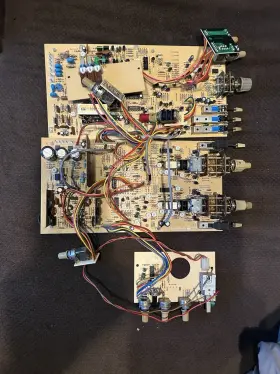
MO-1251A MEGURO Circuit Board Oscilloscope
| Brand | MEGURO |
|---|---|
| Manufacturer Part Number | MO-1251A |
| Part Type | CIRCUIT BOARD OSCILLOSCOPE |
| Oscilloscope Type | ANALOG OSCILLOSCOPE |
| Maximum Bandwidth | 20 MHZ |
Review MEGURO Circuit Board For 20mhz Oscilloscope
The Meguro Mo-1251A circuit board is a high-performance solution designed specifically for use with 20MHz oscilloscopes. This board offers superior signal handling capabilities, ensuring accurate and reliable measurement of electrical signals.
The Mo-1251A circuit board features a low-jitter design, which minimizes the time difference between the rising and falling edges of a signal. This results in improved measurement accuracy and better waveform fidelity, making it an ideal choice for applications where precise timing analysis is required.
This circuit board is designed with a high input impedance, which ensures that it does not load down the signal being measured. This means that the oscilloscope can measure the true characteristics of the signal, without any distortion caused by the input impedance of the probe or the circuit board itself.
The Mo-1251A board also includes a built-in 1:1 probe amplifier, which provides a gain of 1x. This amplifier helps to improve the sensitivity of the oscilloscope, allowing it to measure smaller signals with greater accuracy. The amplifier also has a low noise floor, which ensures that the measurement is not affected by any unwanted noise.
The Meguro Mo-1251A circuit board is designed with a robust construction, using high-quality components and advanced manufacturing techniques. The board is also RoHS compliant, meaning that it does not contain any hazardous substances such as lead, cadmium, mercury, or hexavalent chromium.
Installation of the Mo-1251A circuit board is straightforward, with clear and concise instructions provided by Meguro. The board is compatible with a wide range of 20MHz oscilloscopes, including models from Tektronix, Agilent, and LeCroy, among others.
In summary, the Meguro Mo-1251A circuit board is a high-performance and versatile solution for use with 20MHz oscilloscopes. Its low-jitter design, high input impedance, built-in probe amplifier, and robust construction make it an ideal choice for applications where precise timing analysis and accurate measurement are essential.
The Meguro Mo-1251A circuit board is a popular choice for upgrading the oscilloscope probes of older 20MHz oscilloscopes to provide better performance and additional features. Here are some pros and cons to consider before making a purchase:
Pros:1. Enhanced Performance: The Mo-1251A offers improved bandwidth, signal fidelity, and common mode rejection ratio (CMRR) compared to the stock probes. This leads to better signal resolution and reduced noise, making it easier to analyze complex waveforms.
2. Increased Input Impedance: With a higher input impedance, the Mo-1251A probes minimize the loading effect on the DUT (Device Under Test), allowing you to measure signals with minimal interference and distortion.
3. Wide Dynamic Range: The wide dynamic range of these probes enables accurate measurement of signals with low voltage levels, as well as large voltage swings, making them suitable for a wide range of applications.
4. Additional Features: The Mo-1251A probes offer additional features such as an automatic gain control (AGC) function, which keeps the display amplitude constant regardless of the input signal level. They also have a built-in attenuator, allowing you to adjust the probe sensitivity as needed.
Cons:1. Cost: The Meguro Mo-1251A probes can be more expensive than the stock probes that come with your oscilloscope. This may be a significant investment, especially for those working on a tight budget.
2. Compatibility: The Mo-1251A probes may not be compatible with all oscilloscopes, so it's essential to ensure that they are suitable for your specific model before making a purchase.
3. Calibration: These probes may require regular calibration to maintain their accuracy and performance. Calibration can be a time-consuming and costly process.
Conclusion:The Meguro Mo-1251A circuit board offers several advantages, including enhanced performance, increased input impedance, a wide dynamic range, and additional features. However, the cost and potential compatibility issues may be concerns for some users. Ultimately, whether or not to invest in these probes depends on the specific requirements of your application and your budget. If the benefits outweigh the costs and compatibility is not an issue, then the Meguro Mo-1251A probes can be a valuable addition to your oscilloscope setup.
Details:
Circuit board for Meguro MO-1251A 20mhz oscilloscope.
specifications oscillovectscopes:
- brand: Meguro
- mpn: Mo-1251a
- part type: Circuit Board Oscilloscope
- oscilloscope type: Analog Oscilloscope
- maximum bandwidth: 20 Mhz
general oscillovectscopes:
- category: Business & Industrial > Test, Measurement Inspection > Analyzers Data Acquisition > Oscilloscopes Vectorscopes
seller oscillovectscopes:
- city: san jose, california
- rating: 100.0%
- # reviews: 511
shipping oscillovectscopes:
- class: standard
- transit: 10-14 days
- service: usps ground advantage
- carrier: usps
- type: calculated
offer oscillovectscopes:
- started: november 26, 2025
- options: ship-to-home
- sold #: 13
- availability: in stock
- prices: $12.40–$100.00
- item condition:
- Used
- For parts or not working
- in stock #: 2
returns oscillovectscopes:
- policy: no returns
payments oscillovectscopes:
- credit card: mastercard
- other
- wallet: google-pay
Similar Items:
- Meguro Mo-1254a 50mhz Oscilloscope As-is For parts or repair. Meguro scope with no trace...(April 24th, 2024)
- Meguro Mo-1253 40 Mhz Oscilloscope From a non-smoking home. This ones so nice. Only lightly used by a hobbyist. Even better it still has its original foam packaging and box. Been tested in is great working condition. It shows very little wear or use. If you're looking for one of these this is the you want. Better yet it comes with ...(July 9th, 2025)
