- Oscilloscopes & Vectorscopes Deals
- sku: 3325209787064603
- GW INSTEK GDS-2204A
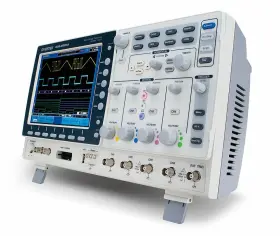
GDS-2204A GW INSTEK Digital Storage Oscilloscope Dso Vpo
| Brand | GW INSTEK |
|---|---|
| Manufacturer Part Number | GDS-2204A |
| Part Type | DIGITAL OSCILLOSCOPE |
| Maximum Bandwidth | 200 MHZ |
Review GW INSTEK Digital Storage Oscilloscope 200mhz 4-channel 2gs/s Dso Vpo
The GW Instek GDS-2204A Digital Storage Oscilloscope is a versatile and powerful instrument designed for advanced electrical measurement applications. This 200MHz, 4-channel DSO (Digital Storage Oscilloscope) boasts an impressive 2GS/s (Gigasamples per second) sampling rate, enabling it to capture and display high-resolution waveforms with unprecedented detail.
At its heart, the GDS-2204A features a 7-inch high-resolution color TFT LCD display, which provides clear and crisp visualization of complex waveforms. The intuitive user interface makes it easy to navigate through various measurement functions and parameters. It includes standard measurement functions such as Voltage, Time, Frequency, and Phase Measurement, as well as advanced features like Automatic Measurement, Curve Tracing, and Math Functions.
This DSO is also equipped with a built-in 20Mpt/s (Mega-points per second) Math Engine, which enables users to perform advanced mathematical calculations in real-time, including averaging, differentiation, integration, and filtering. The built-in pattern generator allows for the generation of various signal types, including sine, square, triangle, pulse, and noise, making it an ideal tool for testing and debugging electronic circuits.
The GDS-2204A Digital Storage Oscilloscope also includes a number of connectivity options, including GPIB, RS-232, and USB interfaces. These interfaces allow for easy integration with other measurement and control systems, making it a valuable tool in complex test environments. The instrument also includes a built-in waveform memory that can store up to 10,000 waveforms, allowing for easy data recall and analysis.
The GW Instek GDS-2204A Digital Storage Oscilloscope is housed in a rugged and compact enclosure, making it ideal for use in a variety of industrial and laboratory environments. It is designed to meet the demanding requirements of electronic design, production, and test applications, offering high accuracy, reliability, and ease of use. Overall, this DSO offers a comprehensive set of features and capabilities, making it an indispensable tool for engineers and technicians working in the field of electronic measurement and analysis.
The GW Instek GDS-2204A Digital Storage Oscilloscope (DSO) is a 200MHz, 4-channel device with a 2GS/s sampling rate. This oscilloscope offers several advantages and disadvantages for users, depending on their specific needs and preferences.
Advantages:1. High Sampling Rate: The GDS-2204A has a sampling rate of 2GS/s, which is relatively high compared to other oscilloscopes in its price range. This makes it an excellent choice for users dealing with fast signals or for those requiring high-resolution analysis.
2. Four Channels: Having four channels allows users to analyze multiple signals simultaneously, reducing the need to switch between channels and improving overall productivity.
3. Large Memory Depth: With a memory depth of 2Mpts, users can capture long signals and analyze them in detail, providing more context and insights into the signals being measured.
4. Wideband DC Input: The GDS-2204A supports wideband DC input, enabling users to measure DC voltages and analyze static signals.
5. Affordable Price: Compared to more expensive oscilloscopes, the GDS-2204A offers a favorable price-performance ratio, making it an attractive option for hobbyists, students, and small businesses.
Disadvantages:1. Limited Bandwidth: While the 200MHz bandwidth is sufficient for many applications, users dealing with high-frequency signals may require a higher bandwidth oscilloscope for accurate analysis.
2. Limited Triggering Modes: The GDS-2204A has fewer triggering modes than more advanced oscilloscopes, which may limit its versatility in certain applications.
3. Limited Software Functionality: The oscilloscope's software may lack some advanced features found in more expensive oscilloscopes, which could impact the user experience.
4. Limited Display Size: The oscilloscope's display size is relatively small compared to some other devices, which could make it harder for users to view complex waveforms or analyze detailed data.
5. Manual Calibration: The calibration process for the GDS-2204A is manual, which can be time-consuming and require more user involvement compared to oscilloscopes with automatic calibration features.
In conclusion, the GW Instek GDS-2204A Digital Storage Oscilloscope offers a good balance of features, performance, and affordability. Its high sampling rate, four channels, large memory depth, and wideband DC input make it an excellent choice for users dealing with fast signals or requiring high-resolution analysis. However, its limited bandwidth, triggering modes, software functionality, display size, and manual calibration process may be drawbacks for some users.
Based on the advantages and disadvantages discussed above, the GDS-2204A is recommended for hobbyists, students, and small businesses that require a high-performance oscilloscope at an affordable price. Those working with high-frequency signals, complex waveforms, or advanced triggering requirements may want to consider a more advanced oscilloscope with a higher bandwidth, more triggering modes, larger display size, and automatic calibration features.
Details:
We calibrate in-house, traceable to Inst. Built-in segmented memory and waveform search functions to optimize the efficiency of record length . Any questions or clarifications, feel free to ask. Gds-2104a and 2204a model's are pictured.
This item is a new Gw Instek GDS-2204A digital storage oscilloscope 200mhz 4 channel 2gs/s dso vpo. Zoom window and play/pause can rapidly navigate the waveform. Meanwhile, with zoom window and play/pause button to scroll through whole displayed waveform, the user can rapidly navigate all waveform in an efficient way. We calibrate your test equipment.
This item comes with a 3 year warranty. Comes with: user manual CD. Gyp-250b-4 250mhz 10:1/1:1 switchable passive probe x4. Consequently, the overall efficiency of memory usage can be enhanced.
specifications oscillovectscopes:
- brand: Gw Instek
- mpn: Gds-2204a
- part type: Digital Oscilloscope
- maximum bandwidth: 200 Mhz
general oscillovectscopes:
- category: Business & Industrial > Test, Measurement Inspection > Analyzers Data Acquisition > Oscilloscopes Vectorscopes
shipping oscillovectscopes:
- class: standard, expedited
- type: fixed
- carrier: ups
- transit: 31-46 days
- service: ups ground, ups 2nd day air
offer oscillovectscopes:
- in stock #: 2
- price: $1899.00
- item condition: New
- sold #: 17
- availability: in stock
- options: ship-to-home
- started: august 22, 2025
returns oscillovectscopes:
- policy: no returns
payments oscillovectscopes:
- other
- wallet: apple-pay
- credit card: discover
seller oscillovectscopes:
- rating: 100.0%
- city: grand prairie, texas
- # reviews: 4515
Similar Items:
- Gw Instek Gds-2102 100mhz 1gsa s Digital Storage Oscilloscope With Usb Interface Get your hands on a high-quality digital storage oscilloscope with USB interface from Gw Instek. This model, GDS-2102, offers maximum real-time sampling rate of 1 GSA/s and band width 100 mhz. This oscilloscope is manufactured in Taiwan and comes with a range of features, including USB connectivity...(December 13th, 2023)
- Gw Gos-658g Oscilloscope 50mhz Two Channel Data Analyzer With Probes Ships Free I ship fast free. Gw oscilloscope GOS-658G 50MHZ two channel data analyzer with probes shown and power card. Unit powers up, but I do not have the expertise to test it further...(December 17th, 2023)
- Gw Instek Gos-620 2 Channel 20mhz Analog Oscilloscope Scope shows signs of use throughout. Does not include any accessories. There are some scuffs on the plastic covering screen...(December 22nd, 2023)
- Gw Gos-622g Instek 2 Channel 20mhz Oscilloscope Working Power cord and probes are not included. No further testing was preformed. This is a Gw Instek GOS-622G analog oscilloscope with maximum band width of 20MHZ. It has been tested using the probe calibration on CH1 and CH2. It has 2 channels and is in working condition. The brand is Gw Instek and the ...(December 25th, 2023)
- Gw Instek Gds-2064 Gwinstek 4-ch Digital Storage Oscilloscope 60mhz Powers On Works Nice Gymnastic GDS-2064 4-CH digital storage oscilloscope 60MHZ powers on works nice...(December 27th, 2023)
- Gw-instek Gds-2204 200mhz 4 Ch D.s.o Color Lcd Usb 1g Sa s Unit Only Unit is missing a nob. The oscilloscope is also portable and comes with a probe USB connectivity for added convenience. With four channels and a maximum band width of 200 mhz, it is perfect for use in wide range applications. Instek color LCD USB 1g SA/s oscilloscope is a high-quality instrument ...(January 8th, 2024)
- Gw Instek Gds-2301a Gds-2304a Digital Oscilloscope 4ch 300mhz It turns on and came from an estate. Don't know how to test it. This Gw Instek GDS-2304A digital oscilloscope is a powerful tool for anyone in the business and industrial sector looking accurate reliable measurements. With a maximum band width of 300 mhz, this digital oscilloscope from Gw Instek ...(January 25th, 2024)
- Gw Instek Gds-820s Digital Storage Oscilloscope 150mhz 2ch I will only warranty that is powers on. The brand name, Gw Instek, is well-known for producing high-quality measuring instruments. Ships with ups ground. The oscilloscope is in good cosmetic condition. With a maximum band width of 150 mhz and 2 channels, it is perfect for use in various industrial ...(February 4th, 2024)
- Gw Instek 622b Model 20 Mhz Analog Oscilloscope Excellent working condition. Gw Instek model 622B 20MHZ 2 channel analog oscilloscope w/probe and power cord. Dimensions 12X8X18 inches, 16 lbs...(February 12th, 2024)
- Gw Instek Gds1054b 50mhz 1gs s Digital Oscilloscope Part #: Gw Instek GDS1054B for sale...(February 12th, 2024)
- Gw Instek Gos-653g 50mhz Oscilloscope If manuals, software, packaging etc. Are not mentioned or pictured, they are included. Gw, GOS-653G, 50MHZ oscilloscope, tested to power on only, I do not have the probes for these, item has wear associated with normal use, marks,scuffles,ext, only what is pictured or mentioned included in the offer...(February 15th, 2024)
