- Oscilloscopes & Vectorscopes Deals
- sku: 4342873165792891
- TEKTRONIX AFG1022
AFG1022 TEKTRONIX Arbitrary Waveform Generator
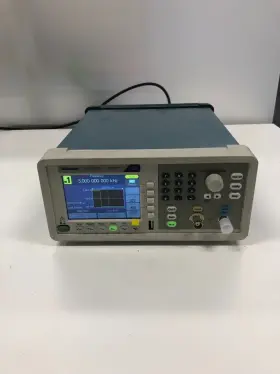
| Brand | TEKTRONIX |
|---|---|
| Manufacturer Part Number | AFG1022 |
| Model | TEKTRONIX AFG1022 |
| Part Type | GENERATOR |
Review TEKTRONIX Arbitrary Waveform Generator
The Tektronix AFG1022 Arbitrary Function Generator is an advanced and versatile instrument designed for generating complex electrical waveforms for various applications in research, education, and industrial settings. This instrument offers a high degree of flexibility and precision, making it an indispensable tool for engineers, scientists, and technicians.
At its core, the AFG1022 is an arbitrary waveform generator, capable of producing virtually any waveform with a frequency range from DC up to 20 MHz and a total waveform capacity of 100 kpoints. This means that it can generate waveforms with great complexity and accuracy, consisting of multiple frequencies, amplitudes, and shapes. The waveform memory is large enough to store and recall up to 32 different waveforms, which can be easily edited using the built-in waveform editor or imported from a computer.
The AFG1022 comes with a user-friendly interface, featuring a high-resolution touchscreen display and intuitive menu system. The user can easily navigate the various functions and settings of the generator, adjusting parameters such as frequency, amplitude, offset, and waveform shape with just a few taps. The instrument also offers various triggering options, including external, internal, and software triggers, ensuring that it can be synchronized with other equipment in a test setup.
The AFG1022 is also equipped with several advanced features that make it a powerful tool for applications requiring high precision and accuracy. These include a built-in frequency counter, which can measure the frequency of an input signal with an accuracy of 0.01%, and a noise generator, which can produce various types of noise, such as white, pink, or Gaussian, for testing and calibration purposes. The instrument also offers various output modes, including voltage, current, and resistance, allowing it to be used in various applications.
The AFG1022 is designed with a robust and rugged construction, ensuring that it can withstand the demands of a laboratory or industrial environment. It features a large front-panel knob for easy and precise frequency adjustment, as well as a high-contrast display for clear and easy-to-read waveform data. The instrument is also equipped with various safety features, such as interlocks and overvoltage protection, to ensure the safety of the user and the equipment.
In summary, the Tektronix AFG1022 Arbitrary Function Generator is a powerful and versatile instrument that offers a high degree of flexibility, precision, and accuracy for generating complex electrical waveforms. Its user-friendly interface, advanced features, and rugged construction make it an essential tool for engineers, scientists, and technicians in various fields, from research and education to industrial applications.
The Tektronix AFG1022 Arbitrary Waveform Generator (AWG) is a versatile and high-performance instrument widely used in various applications such as research, education, and industrial testing. Here are some pros and cons of buying this specific model:
Pros:1. High-resolution waveform generation: The AFG1022 can generate high-resolution waveforms up to 12 bits, ensuring accurate and precise waveform reproduction.
2. Wide bandwidth and frequency range: With a bandwidth of up to 100 MHz and a maximum output frequency of 50 MHz, this AWG can cover a broad range of applications.
3. Large memory capacity: It has an internal memory capacity of 16 Mpts, enabling users to store and recall complex waveforms easily.
4. Digital I/O and triggering capabilities: The AFG1022 offers digital I/O and triggering options, making it suitable for synchronization with other instruments and automation in test setups.
5. User-friendly interface: The Tektronix WaveSurfer software provides an intuitive and powerful interface for creating, editing, and analyzing waveforms.
Cons:1. High cost: The AFG1022 is a premium instrument, and its price might be a significant drawback for some users.
2. Limited analog output voltage: The maximum output voltage is 5 Vpp, which may be insufficient for certain applications requiring higher voltages.
3. Requires external power supply: Unlike some other AWGs, the AFG1022 necessitates an external power supply, adding to the complexity and cost of the setup.
4. Limited analog input: The AFG1022 lacks an analog input, which might be a disadvantage for applications requiring input signal conditioning or processing.
Ending Conclusion:The Tektronix AFG1022 Arbitrary Waveform Generator is an excellent choice for users who require high-resolution, high-performance waveform generation capabilities in their research, education, or industrial testing applications. Its user-friendly interface, wide frequency range, and large memory capacity make it an attractive option. However, its high cost, limited analog output voltage, and the need for an external power supply might be significant drawbacks for some users.
Recommendation:If the AFG1022's features and capabilities align with your application requirements and budget, it is an excellent choice. Alternatively, consider exploring other options from Tektronix or competing brands like Agilent or Rigol, which might offer similar functionality at a lower cost. Always evaluate the specifications, features, and your application requirements before making a purchase decision.
Details:
Key features: continuous, sweeping, burst, and modulation modes am, FM, pm, ask, Fisk, PS, wpm covers most requirements for students other users to get the experiments/test job done. 14 bits, 125 ms/s or 300 arbitrary waveform with 8 k points record length . Free express makes user defined waveform editing extremely easy through an external USB memory stick. Communications experiments.
Item sold as is. It includes two model's with dual channels, up to 60 MHz band width and 10 VP-p output amplitude. The front panel shortcut buttons and rotary knob make accesses to most frequently used functions settings with minimum effort time. Applications: electric and electronics experiments.
Functional test. Standard USB host/device for memory expansion and remote control. The 3.95-inch Taft LCD, short-cut buttons, USB interface and PC software provide the most intuitive ways to configure instrument. Four different run modes cover most use cases with a cost effective solution.
Sensor simulation. Key performance specifications: dual-channel, 25 MHz or 60 sine waveform, 12.5 30 square waveform.
specifications oscillovectscopes:
- brand: Tektronix
- mpn: Afg1022
- model: Tektronix Afg1022
- part type: Generator
payments oscillovectscopes:
- credit card: mastercard
- wallet: google-pay
- other
general oscillovectscopes:
- category: Business & Industrial > Test, Measurement Inspection > Analyzers Data Acquisition > Oscilloscopes Vectorscopes
offer oscillovectscopes:
- options: ship-to-home
- started: april 20, 2026
- sold #: 7
- in stock #: 5
- prices: $320.00–$880.74
- item condition:
- Used
- For parts or not working
- New
- availability: in stock
returns oscillovectscopes:
- policy: no returns
shipping oscillovectscopes:
- type: calculated
- carrier: usps
- class: standard
- service: usps ground advantage
- transit: 11-15 days
seller oscillovectscopes:
- # reviews: 0
- rating: 0.0%
- city: redwood city, california
Similar Items:
- Tektronix B294990 Type 528 Waveform Monitor Parts Not Tested Join our community of positivist enthusiasts by sharing your thoughts and experiences...(January 5th, 2024)
- Tektronix Fg-501a Fg 501a 2mhz Function Generator Plug In Fg501a Power supplies, cables, batteries, and other basic accessories are not included unless stated otherwise. Manufacturer: Tektronix, model: fg 501A, cosmetics: used, test results: specialty collectible. That means less resources and waste are cluttering up the earths environment. This item has been ...(January 16th, 2024)
- Tektronix Oig-502 1ff Oig502 Optical Impulse Generator Part #: Tektronix OIG-502 for sale...(February 16th, 2024)
- Tektronix 1735-hd Multi-format High Definition Waveform Monitor No accessories included. This may mean that serial numbers, dates of manufacture, or other non model specific details do not match our pictures. Has scratches from normal use: included accessories - only whats pictured. Office hours: our office hours are from 9:00 am to 5:00 pm central standard time...(February 25th, 2024)
- Tektronix Lv5150 Leader Lv5150d Hd And Sony Wfm1125 Dual Display Waveform Monitors With Case Sony Tektronix screen size: approximately 4.25 x mechanically sound, tested for full functionality. Leader screen size: approximately 4.75 x does not come with probe or any other accessories aside from the two power chords. Pre loved in great condition. Leader 1125 lines lav 5150D Sony Tektronix ...(February 27th, 2024)
- Tektronix 7854 Waveform Calculator Tektronix 7854 waveform calculator...(March 28th, 2024)
- Tektronix Afg3102c 100 Mhz 1 Gs s Dual Channel Arbitrary function Generator The device is ideal for oscilloscopes and vector scopes suitable use in the business industrial sectors. With a maximum band width of 100 MHz and sampling rate 1 gs/s, it provides accurate precise results for analyzing signals waveform...(March 28th, 2024)
- Tektronix 1720 1710b 1730 Waveform Monitor And 1720 Vectorscope Used This unit was pulled from a working environment and stored in doors after decommissioned. Power cable not included. Powers on - as seen in pictures. This unit is sold as is but likely fully functional. Tektronix 1730 waveform monitor 1720 vector scope - used...(March 31st, 2024)
- Tektronix Afg3021c Used Single Channel Arbitrary Function Generator It comes with a power cord. With my limited use, I cannot find any problems...(April 2nd, 2024)
- Tektronix 1755a Waveform Vector Monitor Pal ntsc Testing Device Whether you are working with oscilloscopes or vector scopes, this device is sure to enhance your workflow and help achieve better results. Invest in the Tektronix 1755A today and take your testing capabilities to next level...(April 13th, 2024)
- Tektronix Rg-501 Rg 501 Ramp Generator Powers Up Sr6 From an extensive private collection. Tested to power on and sold as is...(May 10th, 2024)
